Mt. Hiwi Trust F.A.Q. |
|
|
|
|
The Trust members are people who acknowledge that the responsibility of caring for land in Aotearoa is a privilege. Members presently consist of people from Wellington to New Plymouth and some ex-pats living in the USA. There are 8 Trustees who are responsible for managing the Trust.
The Trust is a legal entity created on the 31st April 2001 to provide a structure for the management of this land. On the 23rd May 2001 it was officially registered with the Companies Office as the Mount Hiwi Charitable Trust.
Anyone can join the Trust, individuals, corporates, families groups or whoever. (see How to Join)
Yes. We have a co-management agreement with Hapu Ngaa Ariki who have a history with this land.
Yes. We have spoken directly to some of the people who whose property borders the land and also others who live nearby. Some are members and the others we have spoken to support what we are doing. Preserving the remaining forest and saving the remaining kiwi and other native creatures appears to be a common desire.
Yes. Lots.
No liabilities. Any payment to the Trust is by means of a donation, similar to a donation to the Forest and Bird Protection Society or Greenpeace, for instance. The Trustees (ie Members of the Trust Board, as distinct from Trust members) have legal responsibilities similar to Company Directors.
No. The Trust is stand alone.
Yes. Lots of trapping for possum, rats & stoats, hunting for goats and pigs.
What, you mean what about the kiwi that have been confirmed (some chicks removed for raising in a safer environment)? Other noteable native birds identified as existing in this area are North Island Robin, grey teal, spotless crake, fern bird, and the NZ falcon. We havn’t seen any falcons but the rest we have seen or heard ourselves.
Oh, and both short tailed and long tailed bats!!!
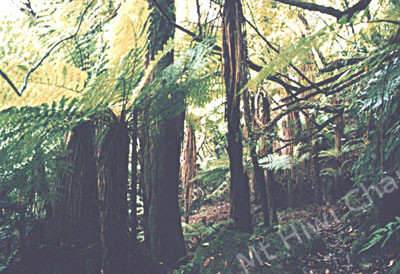
Of note are some very large rimu and at least one enormous beech tree. Abundant specimens of rata, tawa, sedge grass, raupo, toe toe, wheki with pockets of treeferns, not to mention a myriad of smaller plants are also well represented.
We're working on a 500 year plan, which we developed a decade ago and haven't progressed due to focus on completing the property purchase, covenanting and pest control measures. When nearer a state of completiong we'll host is somewhere on this web site.
You get to participate in the creation of a truly natural sanctuary, and gain access to the land and sleep in the cabin (when it's built). Mainly you get to be part of something which exists only to make the world a better place. Lots of real good warm fuzziez and the knowledge that you have actually made a significant contribution to something which actually does (read has, and will continue to) make a difference.
No absolutes can be given, but as far as is practicable, the deed has been designed to prevent this event from occurring. No person has more than one vote per ballot regardless of how many memberships they have or belong to, and there are no proxy votes.
Yes. Paraphrasing clause 7.10 of the deed, if a member is considered to be 'guilty of any grave misconduct likely to reflect unfavourably upon or damage the reputation of the Trust', or 'to impact adversely upon or damage the integrity of the Mount Hiwi Property' then it is possible for three quarters of the Trustees to vote the member from the Trust.
Pick a pest. You name them, goat, deer, pig, rat, or ferret. We possibly have others although we have limited numbers of possums and none of the dinosaur sightings have yet been confirmed. In contrast, we have one unicorn who has been expected to make an appearance for several months however we have confirmation that this has not yet happened. We've had active rat/stoat trapping for at least a decade, with the larger beasts being hunted we can.
The Trust has been formed (and I quote from the Mission Statement…), to:
The Sanctuary area is a block of almost untouched native bush that forms the catchment head for the downstream lakes, which themselves are rather unusual in the Taranaki area. The adjacent buffer block is also uncut, and the Regeneration block provides potential for education and research into sustainable land management.
Two things we’d like to say here. Firstly, the land is not being ‘hidden away’. On the contrary it is changing from being closed off as private land to becoming a relatively accessible and available, communal piece of land. Secondly, it's a question of too little land reserved rather than too much. Such land is necessary as a source of biodiversity, as a habitat for declining native species, and as a token of humanity’s conceptually being able to co-exist with nature in Aotearoa.
WEB: www.mt-hiwi.org.nz
Write: PO Box 132, Waverley, 4544, NZ.
Mobile: Phil on 027 277-1670.
That’s because we’re looking at managing land, and the time scales need to be adjusted accordingly. Choosing 500 years is intended to get across the idea that the land is to be looked after for the benefit of future generations. A 500 year old rimu is barely middle aged.
Finance is coming from a variety of sources, including membership, straight out donations and grants from a variety of sources.
There are three status levels:
Friend of the Trust - Donation of $10 or more.We have set up schemes to allow members the rights of the next membership level if regular payments of at least $10 per week are being received.
Yes. The Trust deed has anticipated that money is not the only contribution members can make. However, given the wide range of possibilities, each application will be assessed individually by the Board of Trustees.
Primarily through the web page and by e-mail. We’d sooner spend money on Trust activities than postage. We also ring each other and talk face to face over coffee. We have also been known to talk while walking through parts of the land. However, please note that this last method is likely to incur copious interuptions by humans ill-aquanted with flying feathers following beaks at speed through the air, and other sights often of more tranquill, if not less startling nature.
(Wow, this FAW was written a while ago) Purchase was completed in 2001 largely thanks to the generosity of Terry Heffernan and the Nature Heritage Fund.
We were aiming for the summer of 2002/2003, but that seems to have passed.
The answer is now (as at 2016)... sometime in the future, but we're not rushing the process.
Members can access the land whenever they wish, so long as the visit is confirmed by a Trustee. This is purely from a safety point of view, to ensure no conflicts with pest hunters, and prevent overbooking of the facilities (anticipating some will be provided in future).
The Trustees are charged with overseeing the health of the land and may at times state that enough is enough and the land needs some space to breathe. If they ask people to stay away it will be because it is in their ward's best interests.
You’ll find it approximately 15km inland from Waverley, see the web site for a detailed account of how to get there. Very South Taranaki.
Geography isn't a constraint for protection of any part of New Zealand. The majority of Trust members Taranaki natives, although we live just about everywhere around (mostly) the north island.
Contact the Trust by phone, e-mail, post, newspaper advertisement or sky-writing. Once we’ve figured out how to answer it, we’ll give you an answer. Chances are we will also add it to this page. See How do I get in touch.